SC Ports opens Cosgrove Avenue extension, new pedestrian bridge

NORTH CHARLESTON, SC—SEPT. 4, 2025—SC Ports marked the opening of the new Cosgrove Avenue extension and pedestrian bridge in North Charleston, a key fixture of the Port’s Navy Base Intermodal Facility (NBIF).

The project extends Cosgrove Avenue above the Port rail yard, which will allow trains to move to and from the facility without impeding local traffic or limiting safe pedestrian access to nearby neighborhoods and businesses.

“The Navy Base Intermodal Facility is a premier project for SC Ports that will allow cargo to move more efficiently from the Port of Charleston to inland markets,” said SC Ports President and CEO Phil Padgett. “While we serve as a Port system for the entire state, SC Ports also recognizes the need to be a good neighbor and local community partner. That means providing solutions for residents who live and work right here in North Charleston.”

City of North Charleston Mayor Reggie Burgess, local and state leaders, and representatives from Navy Yard Charleston and Charleston Moves were in attendance to mark the celebration.

“This new gateway to Riverfront Park marks an important step in the redevelopment of the former Navy Base,” said City of North Charleston Mayor Reggie Burgess. “The opening of the Cosgrove Avenue overpass improves pedestrian safety, enhances mobility and connectivity, and provides residents with more convenient access to economic opportunities, recreational amenities, and future community development.”

The new overpass brings greater access to the neighboring Navy Yard Charleston development, a multi-phase redevelopment that transforms the former Charleston Naval Base into a mixed-use neighborhood, and to Navy Yard Industrial Campus, a historic waterfront facility for maritime, manufacturing, creative, and logistic operations.

“The Cosgrove Avenue extension offers a vital new access point to the historic Naval Base, linking the regional asset to the larger Charleston community and creating new opportunity for driving commerce in North Charleston,” said Steve Dudash, Navy Yard Charleston director of special projects. “Connectivity, particularly multi-modal, is the key to great placemaking, livability, and business success. This new infrastructure is pivotal to the area’s growth potential, and we commend SC Ports on the project’s completion.”

A 12-foot wide multi use path, separated by a barrier, will run along the bridge, providing safe access for pedestrians to nearby neighborhoods and attractions.

"We appreciate the thoughtfulness applied to vulnerable road users by SC Ports for this project,” said Katie Zimmerman, executive director of Charleston Moves. “It is an example of how every infrastructure project in our region should plan for and include multiple modes of transportation, safely and enjoyably connecting our industry, neighborhoods, and parks well into the future."

SC Ports also expects to complete construction on a nearby community recreation center in North Charleston’s Chicora-Cherokee Neighborhood this fall. The 15,000 square foot facility is part of SC Port’s commitment to mitigate impacts from NBIF.
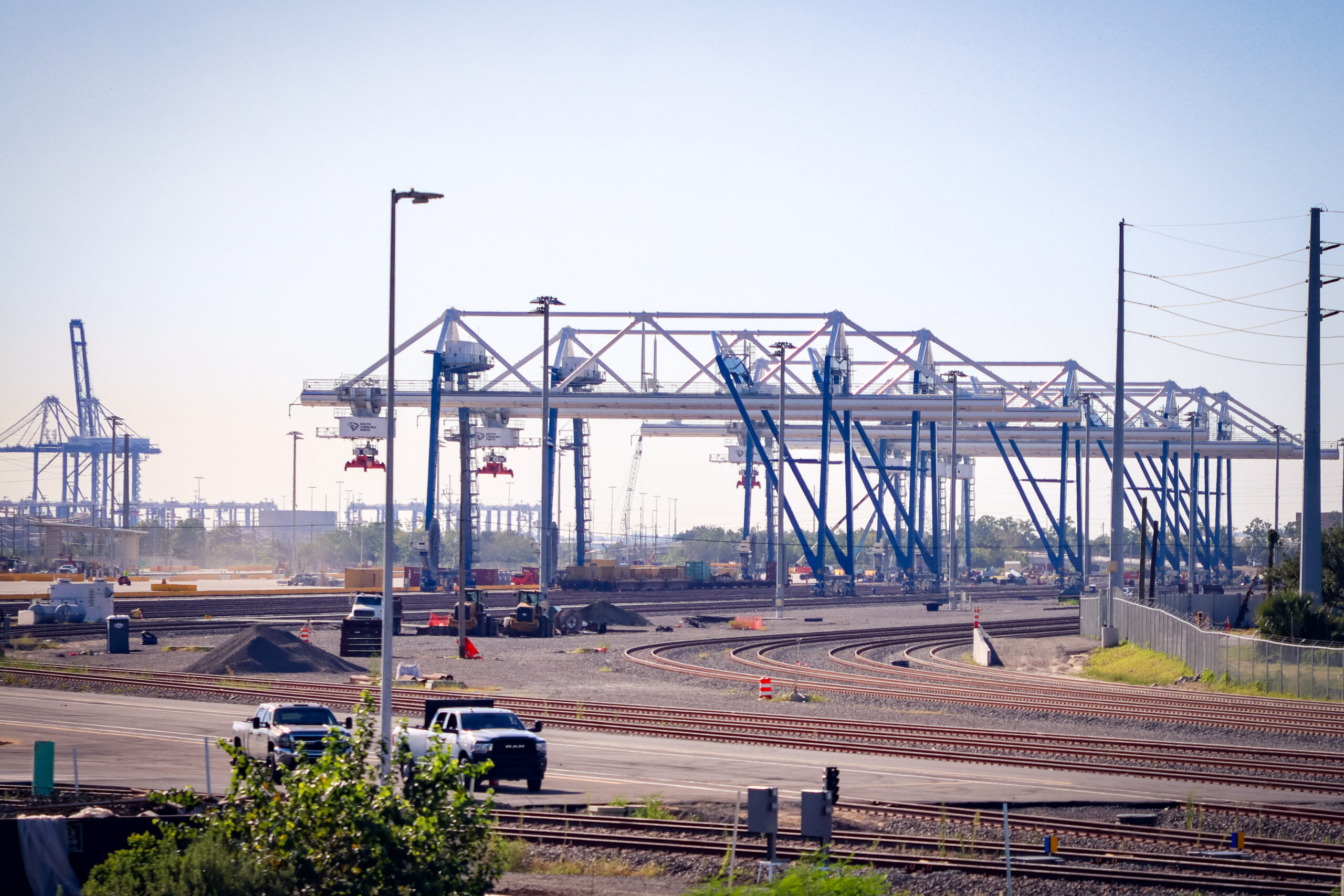
The project extends Cosgrove Avenue above the Port rail yard, a key fixture of the Port’s Navy Base Intermodal Facility (NBIF). (Photo/English Hurteau)

About South Carolina Ports

South Carolina Ports owns and operates marine terminals at the Port of Charleston and two rail-served inland ports in Greer and Dillon. As the 8th largest U.S. container port, SC Ports connects port-dependent businesses throughout the Southeast and beyond to global markets. SC Ports proactively invests in infrastructure ahead of demand to provide reliable service, efficient operations, cargo capacity, an expansive rail network and the deepest harbor on the East Coast at 52 feet. SC Ports is a vital economic engine for South Carolina, with port operations supporting 1 in 9 jobs statewide. Learn more: scspa.com.

SC Ports Welcomes 2025–26 Port Ambassador Class

CHARLESTON, SC—AUG. 28, 2025—SC Ports announced its 2025-2026 Port Ambassador class, welcoming 30 South Carolina professionals to join the program for its ninth year.

The group of community and business leaders will meet monthly September through May to get a firsthand look at how SC Ports’ operations spur economic growth in the entire state and support the broader Southeast supply chain. Participants will engage directly with Port leadership, tour inland and ocean terminals, and meet with port-dependent business owners who rely on SC Ports to connect them to markets around the world.

“The Port Ambassador program is a unique opportunity to connect leaders from across the state with the operations that keep South Carolina’s economy moving,” said Ashley Iseman, SC Ports’ director of executive office operations, who co-leads the program. “Our ambassadors will see how port infrastructure and innovation directly support business, jobs, and communities in every corner of the state.”

Other program highlights include attendance to the annual State of the Port address, and discussions on global trade, economic competitiveness, and infrastructure investment in South Carolina.

“SC Ports plays a critical role in ensuring South Carolina remains globally competitive,” said Michael Jackson, program co-lead and SC Ports’ director of federal and state government strategy. “The Port Ambassador Program builds a network of informed leaders who can share the Port’s story, highlight its economic impact, and champion the importance of investing in port infrastructure to benefit future generations of South Carolinians.”

This year’s program kicks off in September with a tour of the Wando Welch Terminal and a deep dive into the inner workings of the Port of Charleston.

2025-2026 Ambassadors:

  • Brenton Brown, South Carolina Commission for Community Advancement and Engagement
  • David Chinnis, Dorchester County Council
  • Rob Godfrey, Godfrey Communications and Public Affairs
  • John Gregory, NAI Columbia
  • Matthew Hamrick, Mercedes-Benz Vans, LLC
  • Joseph Maybank Howell, Sopris Capital Private Equity
  • Toni Rice Huston, Macatuck
  • Thomas J. Johnson, Conway Ford, Inc.
  • Michael Kearney, Jr., Charleston Promise Neighborhood
  • Payton Lang, City of Columbia
  • Dylon Ligon, South Carolina Department of Commerce
  • William McCall, Santee Cooper
  • Peden Brown McLeod, Jr., Bank of the Lowcountry
  • Carter McMillan, Charleston County Government
  • Brooks A. Melton, Beacon Community Bank
  • Campbell Mims, Tompkins Thompson & Brown Government Affairs
  • Christopher Austin Murphy, Samet Corporation
  • Jennifer Necker, South Carolina Department of Transportation
  • AJ Newton, South Carolina Technical College System
  • Trey Pennington, CBRE, Inc.
  • Sigrid Phinney, South Carolina Law Enforcement Division
  • Derrek Pugh, Richland County Council and United Cerebral Palsy of South Carolina
  • Edward Rawl, The Boeing Company
  • Mary Sale, Dominion Energy South Carolina
  • Richard Sturm, Ameris Bank
  • Chase Talbert, Bank of the Lowcountry
  • Erika D. Williams, The LINK Economic Development Alliance
  • John O. Williams II, Berkeley County Government
  • Erica Wright, Municipal Association of South Carolina
  • Saluda Zemp, South Carolina Governor's Office

About South Carolina Ports

South Carolina Ports owns and operates marine terminals at the Port of Charleston and two rail-served inland ports in Greer and Dillon. As the 8th largest U.S. container port, SC Ports connects port-dependent businesses throughout the Southeast and beyond to global markets. SC Ports proactively invests in infrastructure ahead of demand to provide reliable service, efficient operations, cargo capacity, an expansive rail network and the deepest harbor on the East Coast at 52 feet. SC Ports is a vital economic engine for South Carolina, with port operations supporting 1 in 9 jobs statewide. Learn more: scspa.com.

SC Ports announces leadership change

CHARLESTON, SC—Aug. 21, 2025—After three years of leading the South Carolina Ports Authority as President and CEO, Barbara Melvin has announced her resignation, with plans to pursue other opportunities.

Melvin joined SC Ports in 1998, serving in a variety of roles and leading major infrastructure initiatives like the Charleston Harbor Deepening Project.

“I am grateful for the opportunity to have served South Carolina and the Ports Authority over these many years,” said Melvin. “However, for personal and professional reasons, I want to pursue other opportunities. I take pride in what has been accomplished by the Port while I have served it in multiple roles. Knowing the resiliency of the Ports Authority and its people, I have no doubt even more success is in its future,” said Melvin.

Bill Stern, Chairman of the SC Ports Board of Directors, accepted her resignation on behalf of the Board.

“The Board thanks Barbara for her long public service to the State through her work at the Ports Authority,” said Stern. “She has been instrumental in moving the Ports Authority in a positive direction as CEO these last three years and advancing several critical infrastructure projects, including overseeing the reopening of the Leatherman Terminal. We wish her the best as she embarks upon new challenges and opportunities.”

Chief Financial Officer & VP, Administration, Phillip Padgett has been named as interim CEO, effective immediately.

Padgett joined SC Ports in 2016 as Controller. As CFO he is responsible for the financial, risk management and real estate activities of the Port.

“I look forward to continue serving the Port and leading our team as interim CEO until a replacement is named,” said Padgett. “SC Ports remains committed to providing reliable and efficient port service to our customers, and continuing to serve as a trusted partner to the entire South Carolina maritime community.”

About South Carolina Ports

South Carolina Ports owns and operates marine terminals at the Port of Charleston and two rail-served inland ports in Greer and Dillon. As the 8th largest U.S. container port, SC Ports connects port-dependent businesses throughout the Southeast and beyond to global markets. SC Ports proactively invests in infrastructure ahead of demand to provide reliable service, efficient operations, cargo capacity, an expansive rail network and the deepest harbor on the East Coast at 52 feet. SC Ports is a vital economic engine for South Carolina, with port operations supporting 1 in 9 jobs statewide. Learn more: scspa.com.

Infrastructure investments move ahead, new services announced for Port of Charleston

CHARLESTON, SC—Aug. 19, 2025—Construction continues on two key infrastructure projects at the Port of Charleston that will enhance SC Ports’ rail capabilities and grow capacity at the Leatherman Terminal.

At the Leatherman Rail Facility, set to open in early 2026, all six electric rail-mounted gantry cranes (RMGs) have been erected, and work by Kuenz to commission the cranes has begun. Upon completion, the facility will be capable of handling 1 million rail lifts per year. Progress is also being made on the one-mile, dedicated drayage road that will segregate intermodal traffic from Interstate 26.

“The investments SC Ports makes today, with backing from our state leaders, keep our port system ready to meet projected demand,” SC Ports President and CEO Barbara Melvin said. “The continued growth of our inland rail facilities, and our commitment to enhancing efficiency for our customers necessitated this critical infrastructure expansion, and will keep SC Ports competitive as a top 10 U.S. container port for decades to come.”

Phase two of the Leatherman Terminal expansion is underway. Test piles for the wharf extension have been installed, the first step in extending the wharf an additional 1,600 feet, which will create space for an additional five ship-to-shore cranes.

New services announced for Leatherman Terminal

MSC, the largest carrier in the world and SC Port’s largest carrier customer, will launch two new weekly services at the Port of Charleston, driving cargo growth and connectivity for shippers in the Southeast. The Albatros and Dragon services, both transatlantic services, will begin calling the Leatherman Terminal in September, and connect shippers in the Southeastern U.S. with North Europe, the Mediterranean and Asia.

“SC Ports proudly welcomes the Albatros and Dragon services to Charleston,” Melvin said. “This announcement comes as the Southeastern U.S. is experiencing tremendous growth. Our investments made in achieving the deepest Harbor on the East Coast at 52 feet, and SC Ports’ reputation for efficiently working ships makes the Port of Charleston a reliable partner for MSC.”

Both services will deploy 15,000 TEU vessels, among the largest weekly services to call the Port of Charleston. The Albatros service is an exclusive call for the Port of Charleston in the Southeast.

July volumes

SC Ports handled 213,177 total TEUs, and 117,059 pier containers during the first month of fiscal year 2026.

Both Inland Port Greer and Inland Port Dillon set a record for rail moves in July, continuing a trend of posting year-over-year growth. Greer handled 17,739 rail moves, up 2% over the prior year, and Dillon handles 4,059 rail moves, up 10%, for a combined total of 21,798 rail moves.

Vehicles imports and exports totaled 16,628, marking a strong improvement over last July at 53% growth.

About South Carolina Ports

South Carolina Ports owns and operates marine terminals at the Port of Charleston and two rail-served inland ports in Greer and Dillon. As the 8th largest U.S. container port, SC Ports connects port-dependent businesses throughout the Southeast and beyond to global markets. SC Ports proactively invests in infrastructure ahead of demand to provide reliable service, efficient operations, cargo capacity, an expansive rail network and the deepest harbor on the East Coast at 52 feet. SC Ports is a vital economic engine for South Carolina, with port operations supporting 1 in 9 jobs statewide. Learn more: scspa.com.

SC Ports Receives Final Federal Reimbursement for Harbor Deepening Project

CHARLESTON, SC—August 18, 2025—The final federal reimbursement for the Charleston Harbor Deepening Project has been disbursed to the South Carolina Ports Authority, a total of $21.28 million allocated by Congress in the U.S. Army Corps of Engineers Charleston District’s Fiscal Year (FY) 2025 Work Plan.

This funding milestone concludes the $580 million deepening initiative, completed just a few years after Charleston Harbor became the deepest harbor on the U.S. East Coast at 52 feet.

The project strengthens SC Ports’ competitiveness by allowing the world’s largest container ships to call on the Port of Charleston at any time, removing tidal restrictions, improving efficiency, and attracting new shipping services and business investment.

Senator Lindsey Graham has been a driving force behind this transformational project from its outset in 2011. It was through his advocacy on behalf of the South Carolina delegation, coordination with federal agencies, and navigation of legislative channels that critical federal funds were directed toward this venture, ultimately securing the final reimbursement included in the FY 2025 Work Plan.

“Infrastructure projects like the Harbor Deepening Project are massive undertakings that require collaboration and teamwork with our state and federal leaders,” SCPA President and CEO Barbara Melvin said. “We were able to get this project across the finish line and get reimbursed expeditiously, thanks to Sen. Graham’s leadership and over a decade of tenacious hard work. We are thankful for his support so SC Ports can continue to remain competitive in the thriving Southeast.”

“This is great news for the Port of Charleston and the people of South Carolina. Success doesn’t just happen—you’ve got to roll up your sleeves and stay engaged—and that’s what we did,” Senator Graham said.

“As a state, federal and local team, we devised a creative solution to ensure that SC Ports had the deepest harbor on the East Coast. The deepening of the Charleston Harbor is about jobs – both today and in the future. It also ensures that the Port remains a multi-billion dollar economic engine that will continue to benefit South Carolina and the rest of the country. Governor McMaster, Senator Leatherman and their colleagues invested state money up front to make sure the harbor deepening project stayed on track. I committed early on to ensure the federal government reimbursed South Carolina for this important investment. With this announcement from the Army Corps of Engineers, we have fulfilled that promise. I am very grateful to the Trump Administration for making this happen,” Graham said.

Receipt of the final component of federal funding brings to a close a chapter of close coordination among federal, state and local officials. As a federal waterway, the project relied on receipt of federal funding for completion, which required stewardship from the state’s Congressional delegation.

“Completing the largest project in our District’s history, on time and within budget, is a testament to the strength of our partnership with the South Carolina Ports Authority, Senator Graham, and other state and federal leaders,” Lt. Col. Todd Mainwaring, district commander, U.S. Army Corps of Engineers, Charleston District said. “Together, we moved over 40 million cubic yards of material to make Charleston Harbor the deepest on the East Coast. This project is more than an engineering milestone; it’s a strategic investment in our Nation’s infrastructure and economic future.”

The harbor deepening was funded through a partnership of state and federal resources.

Background & Historical Context

2011–2012: Senator Lindsey Graham champions initial efforts to deepen Charleston Harbor, engaging federal partners to support funding and project planning.

2015: Authorization is received from Congress. 

2018: Construction begins.

2022–2023: Charleston Harbor reaches a depth of 52 feet, marking the deepest harbor along the U.S. East Coast.

2025: The final $21.28 million federal reimbursement is designated by the U.S. Army Corps of Engineers and officially awarded to the State.

Looking Ahead

The Harbor Deepening Project is part of SC Ports’ broader infrastructure strategy, including waterside, terminal, and landside improvements. These investments are expected to triple port capacity, improve cargo flow, and further solidify Charleston’s position as a key link in global supply chains, strengthening the economy across South Carolina and the Southeast.

About South Carolina Ports

South Carolina Ports owns and operates marine terminals at the Port of Charleston and two rail-served inland ports in Greer and Dillon. As the 8th largest U.S. container port, SC Ports connects port-dependent businesses throughout the Southeast and beyond to global markets. SC Ports proactively invests in infrastructure ahead of demand to provide reliable service, efficient operations, cargo capacity, an expansive rail network and the deepest harbor on the East Coast at 52 feet. SC Ports is a vital economic engine for South Carolina, with port operations supporting 1 in 9 jobs statewide. Learn more: scspa.com.

Railed cargo, container volume grows at SC Ports in FY25

CHARLESTON, SC — JULY 21, 2025 — South Carolina Ports finished fiscal year 2025 with steady container volumes and record rail moves.

The South Carolina maritime community efficiently handled 2.6 million TEUs in fiscal year 2025, which is up 3% from the year prior. Goods moving via rail — between the Port of Charleston and SC Ports’ two rail-served inland ports — are up 4% for the fiscal year.

While shippers and carriers alike continue to navigate a shifting trade landscape, SC Ports offers consistent port performance and reliable port service for their supply chains.

Charleston’s deep harbor provides two-way vessel traffic for expedited logistics, and SC Ports’ highly productive terminals yield fast crane moves, swift truck turn times and instant access to imports.

“South Carolina Ports and our maritime community operate a well-run port with quick access to the U.S. Southeast market, benefitting mega retailers, advanced manufacturers, refrigerated goods shippers, farmers and small businesses,” SC Ports President and CEO Barbara Melvin said. “Our customers know we deliver excellent port service and personalized solutions for their supply chains, which is especially needed now.”

Railed cargo remains a huge growth area for SC Ports. Inland Port Greer had a record fiscal year 2025 with 205,523 total rail moves, which is up nearly 10% from the year prior. The rail-served inland port broke 200,000 rail moves within a 12-month period for the first time, highlighting the importance of its recent expansion, which doubles its cargo capacity and increases rail capabilities.

Inland Port Dillon volumes steadied in the second half of the year, with 33,838 rail moves for fiscal year 2025. SC Ports also had 165,949 total finished vehicles cross the docks during fiscal year 2025.

SC Ports will continue growing its market share as more goods flow into the Port of Charleston, while also proactively investing in infrastructure to support the region’s growth.

“We have a long-term growth plan to expand cargo capacity at the Port of Charleston on a pathway to 10 million TEUs and intermodal capabilities throughout the state — including building a second berth at Leatherman Terminal and opening our near-port rail yard in 2026,” Melvin said. “The Leatherman Rail Yard will provide customers with speed to market, enhanced cargo visibility and 1 million rail lift capacity to handle more goods.”

About South Carolina Ports

South Carolina Ports owns and operates marine terminals at the Port of Charleston and two rail-served inland ports in Greer and Dillon. As the 8th largest U.S. container port, SC Ports connects port-dependent businesses throughout the Southeast and beyond to global markets. SC Ports proactively invests in infrastructure ahead of demand to provide reliable service, efficient operations, cargo capacity, an expansive rail network and the deepest harbor on the East Coast at 52 feet. SC Ports is a vital economic engine for South Carolina, with port operations supporting 1 in 9 jobs statewide. Learn more: scspa.com.

SC Ports brings reliability, speed to market to customers

CHARLESTON, SC — JUNE 19, 2025 — As the broader supply chain and global markets face a great deal of uncertainty, South Carolina Ports is supporting customers with reliable port service and creative solutions.

“SC Ports is a well-run port with highly productive operations,” SC Ports President and CEO Barbara Melvin said. “We are proactively supporting our customers amid shifting policies and economic uncertainties.”

Customers benefit from expedited logistics at the Port of Charleston. With the deepest harbor on the U.S. East Coast, ships can access port terminals any time, regardless of tide, allowing berths to remain fluid. South Carolina’s maritime community quickly works ships, averaging 33 crane moves per hour.

SC Ports’ operations are designed to speed goods to market — customers can instantly access imports; trucks average 35-minute turn times; and nearby rail yards connect to two rail-served inland ports in the state and inland markets throughout the Southeast.

“South Carolina’s port industry is here to support our customers as they navigate market uncertainties and disruptions,” SC Ports Chief Commercial Officer Byron Miller said. “Customers can count on us to provide reliable port service and develop creative, flexible solutions. This ensures cargo flows efficiently between supplier and buyer, helping our customers meet their supply chain objectives.”

FY26 infrastructure investments

SC Ports’ Board of Directors approved on Tuesday a $294 million capital plan for fiscal year 2026 to fund critical port infrastructure. The funding will support completing the Navy Base Intermodal Facility, expanding Leatherman Terminal with a second berth, and upgrading Columbus Street Terminal to enhance resiliency for ro-ro operations.

The Navy Base Intermodal Facility is already more than 80% complete, and once fully operational, the rail-served cargo yard will swiftly move goods between the Port of Charleston and inland markets via CSX and Norfolk Southern rail.

“Regardless of short-term economic fluctuations, the port is a long-cycle business. We are investing today to have the capacity to support our customers for decades to come,” Melvin said. “South Carolina’s economy and population are thriving, and these strategic investments enable us to handle current cargo volumes, and the cargo that will flow from future investments and population growth in the Southeast.”

May volumes

The South Carolina port community efficiently handled 120,796 pier containers and 219,255 TEUs, a 21% and 22% increase from last year, respectively. Loaded imports were up 19% from last May, and loaded exports were up 10% from a year ago.

Container volumes from February through May were consistently stable or higher-than-expected, given the ongoing uncertainty in the market.

Railed cargo remains solid. Inland Port Greer achieved a record May with 16,952 rail moves, representing 11% growth. Inland Port Dillon was right on par with last May, handling 3,856 rail moves.

The maritime community moved 13,062 vehicles across the docks, which is in line with last year’s volumes.

“Our South Carolina port team, broader maritime community, rail partners and logistics companies work together every day to support companies’ supply chains, ensuring we remain competitive as the No. 8 container port in the country,” Melvin said.

About South Carolina Ports

South Carolina Ports owns and operates marine terminals at the Port of Charleston and two rail-served inland ports in Greer and Dillon. As the 8th largest U.S. container port, SC Ports connects port-dependent businesses throughout the Southeast and beyond to global markets. SC Ports proactively invests in infrastructure ahead of demand to provide reliable service, efficient operations, cargo capacity, an expansive rail network and the deepest harbor on the East Coast at 52 feet. SC Ports is a vital economic engine for South Carolina, with port operations supporting 1 in 9 jobs statewide. Learn more: scspa.com.

SC Ports maintains productive, reliable service in Southeast

CHARLESTON, SC — MAY 15, 2025 — South Carolina Ports remains focused on providing highly productive, reliable port service to support companies’ supply chains throughout the Southeast and beyond.

“As carriers and shippers navigate current market conditions, customers can count on SC Ports and our broader port community to deliver quality port service,” SC Ports President and CEO Barbara Melvin said. “We excel at quickly working ships and moving goods through our terminals. We have available chassis, trucking capacity and rail connections to further speed goods to market.”

Charleston’s 52-foot harbor depth further expedites logistics, and new carrier services at the Port of Charleston provide shippers with much-needed flexibility and access to key markets.

“SC Ports’ ocean carrier services are diverse and span various trade lanes, which can help mitigate disruptions in region-specific supply chains,” Melvin said. “With 29 weekly services at the Port of Charleston, and critical first-in calls from key markets in Asia and Europe, imports and exports swiftly flow between the U.S. Southeast and international markets.”

In April, the Port of Charleston handled 215,804 TEUs and 118,215 pier containers, which is flat compared to the year prior. Container volumes remained relatively consistent in April, following two months of container growth.

Vehicle imports and exports at the Port of Charleston totaled 12,339 in April, representing a 32% decrease from last year.

Railed cargo continues to be a bright spot, with both Inland Ports Greer and Dillon handling strong volumes in recent months.

Inland Port Greer achieved a record April with 18,394 rail moves, representing 14% growth from last April. Greer’s recent expansion increases cargo capacity by 50%, enabling the rail-served inland port to handle 300,000 rail lifts to support growing customer demand in the region.

Inland Port Dillon handled 4,213 rail moves in April. This is down 11% year-over-year, but breaks 4,000 rail moves for the first time this fiscal year.

SC Ports is on track to move more goods via rail when SC Ports opens the near-port Navy Base Intermodal Facility (NBIF). Construction is progressing well at the cargo yard, which will be rail-served by both CSX and Norfolk Southern. This will provide direct connections to Inland Ports Greer and Dillon, and further enhances South Carolina’s rail access to key markets like Atlanta, Memphis, Nashville, Louisville and beyond.

“We are proactively investing in our port terminals and rail infrastructure to support the growth occurring in the Southeast for the long-term,” Melvin said. “As volumes fluctuate in the short term, we are committed to providing fluidity for companies’ supply chains.”

About South Carolina Ports

South Carolina Ports owns and operates marine terminals at the Port of Charleston and two rail-served inland ports in Greer and Dillon. As the 8th largest U.S. container port, SC Ports connects port-dependent businesses throughout the Southeast and beyond to global markets. SC Ports proactively invests in infrastructure ahead of demand to provide reliable service, efficient operations, cargo capacity, an expansive rail network and the deepest harbor on the East Coast at 52 feet. SC Ports is a vital economic engine for South Carolina, with port operations supporting 1 in 9 jobs statewide. Learn more: scspa.com.

SC Ports Graduates 2025 Port Ambassador Class

CHARLESTON, SC — MAY 9, 2025 — SC Ports celebrates the 30 South Carolina professionals who completed the 2024-2025 Port Ambassador program.

Throughout the past year, the group toured the Port’s ocean and inland terminals, attended the State of the Port address, and met with port-dependent businesses around the state, giving them a first-hand look at how port operations drive an $87 billion statewide economic impact each year.

“There is no better way for our state’s professionals to understand how the Port spurs economic prosperity in every corner of our state, than by having the opportunity to see our operations up close,” SC Ports President and CEO Barbara Melvin said. “We appreciate our supply chain and economic development partners who recognize the value of the Port Ambassador Program and take the time to show participants how the Port connects South Carolina businesses to markets around the world.”

This year’s participants were the first to tour construction progress at the Navy Base Intermodal Facility, which will soon provide near-dock rail to the Port of Charleston, and the recently reopened Hugh K. Leatherman Terminal.

“The Port Ambassador Program provided a well-defined opportunity to better understand the statewide operations and impacts of SC Ports,” said Ryan Johnson, Director of Administration with the City of North Charleston. “The Port’s reach extends far beyond the docks, shaping our communities, influencing our infrastructure, and playing a fundamental role in enriching the state’s economy and workforce. Building strong and lasting connections between the Port and stakeholders is vital as South Carolina continues to progress.”

The Port Ambassador Program is designed to increase public understanding of SC Ports’ role in our state’s economy. The program has graduated more than 200 participants since its launch in 2016.

2024-2025 Ambassadors:

  • Jay Byars, Dorchester County Council
  • Clay Chester, Keowee Pools
  • Randy Cole, OVP Health
  • Brooks Courtney, Bridge Commercial
  • Detrice Dawkins, Dillon County Council
  • Carla Edwards, SC Dept of Commerce
  • Austin Floyd, Sumter Adult Education
  • Andy Fulghum, Jasper County
  • Chris Gaskins, SC Dept of Transportation
  • Michael Glenn, SouthState Bank
  • Hayden Grooms, Miller Dawson Sigal & Ward
  • Trent Holland, Huntington National Bank
  • Jenny Honeycutt, Costa Honeycutt, Charleston County Council
  • Elizabeth Jablonski, Dominion Energy
  • Ryan Johnson, City of North Charleston
  • Jamie Lominack, RealtyLink Development Co.
  • Fredy Madrid, Gibbs International
  • Charles Marshall, Dominion Energy
  • Nick Pye, South Carolina Highway Patrol
  • Jake Reed, Reed Commercial Partners
  • Charisse Reichenbach, Reichenbach Automotive
  • Faith Rivers James, SC Coastal Conservation League
  • Chris Scott, Pearce Land Company
  • Fernanda Ceva (Sieverling), European American Chamber of Commerce- Carolinas
  • Leslie Skardon, Sustain SC
  • Yarley Steedly, Coastal Conservation League
  • Amy Stern, Berkeley County Council
  • Phillip Taylor, Colleton County Council
  • John Wienges, SC Association of Counties
  • Ryan Young, Cushman & Wakefield

About South Carolina Ports

South Carolina Ports owns and operates marine terminals at the Port of Charleston and two rail-served inland ports in Greer and Dillon. As the 8th largest U.S. container port, SC Ports connects port-dependent businesses throughout the Southeast and beyond to global markets. SC Ports proactively invests in infrastructure ahead of demand to provide reliable service, efficient operations, cargo capacity, an expansive rail network and the deepest harbor on the East Coast at 52 feet. SC Ports is a vital economic engine for South Carolina, with port operations supporting 1 in 9 jobs statewide. Learn more: scspa.com.

SC Ports provides consistent fluidity, deepest harbor for expedited logistics

CHARLESTON, SC — APRIL 15, 2025 — With a key infrastructure project now complete, SC Ports’ busiest container terminal can once again handle three mega container ships simultaneously at any tide, providing expedited logistics and consistent fluidity for ocean carriers calling the Port of Charleston.

Wando Welch Terminal’s new toe wall — a new steel wall that runs along the terminal’s wharf — further strengthens the terminal to handle bigger ships and maintain deeper depths. Additional dredging in front of the terminal reinforces Charleston Harbor’s 52-foot-depth.

“With the deepest harbor on the U.S. East Coast and strategic port investments at our terminals, SC Ports can efficiently handle the biggest ships at any tide,” SC Ports President and CEO Barbara Melvin said. “These investments save our customers time and money. Ocean carriers can access our terminals without waiting, and we provide highly productive port service to quickly work ships and speed goods to market.”

SC Ports’ operations and berthing team worked alongside maritime partners to implement creative solutions for customers whenever construction limited the terminal to two berths.

“We are grateful to our customers for their incredible support as we navigated this critical infrastructure project, which will pay dividends to companies’ supply chains,” Melvin said. “Wando Welch Terminal is a powerhouse terminal, and with three berths fully open again, we are providing berth fluidity and reliable port service for our customers.”

SC Ports’ engineering team managed the 14-month wharf toe wall project, with WSP USA leading design and Mead and Hunt overseeing construction.

Russell Marine LLC installed steel sheet piles underwater and buried them into the channel bottom to reinforce the existing slope underneath the wharf. Marinex Construction Inc. completed the berth deepening.

The toe wall project and dredging cost roughly $23 million, with $11.2 million coming from a 2019 USDOT Maritime Administration Port Infrastructure Development Program (PIDP) grant.

March volumes

The SC Ports team and maritime community handled 240,857 TEUs and 131,513 pier containers in March, up 11% compared to March 2024. This is the second consecutive month of stronger container volumes, following more tempered monthly volumes.

Rail-served Inland Ports in Greer and Dillon also performed well last month. Inland Port Greer handled 19,291 rail moves, up 20% from last year. This is an all-time record for the Upstate inland port, which recently completed a significant expansion to handle more cargo. Inland Port Dillon continued to see growth with 3,287 rail moves in March, up 14% year-over-year.

The maritime community handled 20,483 vehicles at the Port of Charleston in March, which represents 14% growth from last year.

“While we anticipate volume fluctuations amid economic uncertainties, we are encouraged to see stronger volumes across all our business segments,” Melvin said. “We celebrate our maritime community, who works together every day to keep freight moving for port-dependent businesses throughout the Southeast and beyond.”

1 2 3 4 74